Chapter 1: Introduction
Introduction
-
In this chapter, we will provide an overview of the Drawbridge project, including a general introduction to the idea behind it, the problem it aims to solve, and the objectives we seek to achieve. We will also present the main resources required for the development process, describe the methodology we followed, and explain how this report is organized across its chapters.
Problem domain
-
The Drawbridge project focuses on small to medium-sized enterprises (SMEs), especially new entrepreneurs in retail and hospitality sectors such as cafés, groceries, and restaurants. These businesses need a platform that allows them to order, restock, and manage their inventory efficiently while acting as a bridge between them and wholesalers.
Problem statement
-
Businesses lack a reliable B2B central marketplace Platform that acts as an intermediary. The primary challenges are limited access for all wholesalers, inefficient inventory management, restocking, and reordering of products, which are often limited processes, prone to human error, and significant administrative overhead. This leads to time-consuming procurement cycles and a lack of visibility in the broader market. Inventory shortages directly result in lost sales, decreased customer satisfaction, and potential damage to a business’s reputation.
Proposed system
The Drawbridge platform is an online marketplace for businesses, which is a B2B e-commerce platform, designed to connect small business owners with wholesalers or manufacturers of consumer goods. Supply from one place with thousands of products in a single app from various brands and different wholesalers at the best prices, with many inventory management features such as Automatic restocking and monitoring inventory levels via using the inventory features available on the platform that allows you to organize your stock and the orders you need on a regular basis.
Aims and Objectives
The primary aim of the Drawbridge project is to enhance the operational efficiency of small and medium-sized enterprises (SMEs) by providing an integrated platform for streamlined procurement and automated inventory management.
The objectives include:
-
Centralize Access to Wholesale Markets: Provide small business owners with a single platform to access thousands of products from various brands and wholesalers.
-
Simplify Inventory Management: Offer robust inventory management features, such as automatic restocking and inventory level monitoring.
-
Optimize Supply Chain Operations: Enable businesses to streamline their stock and order management processes efficiently.
-
Promote Scalability: Support small businesses in scaling their operations by providing tools to handle increased demand and stock requirements.
Proposed system features
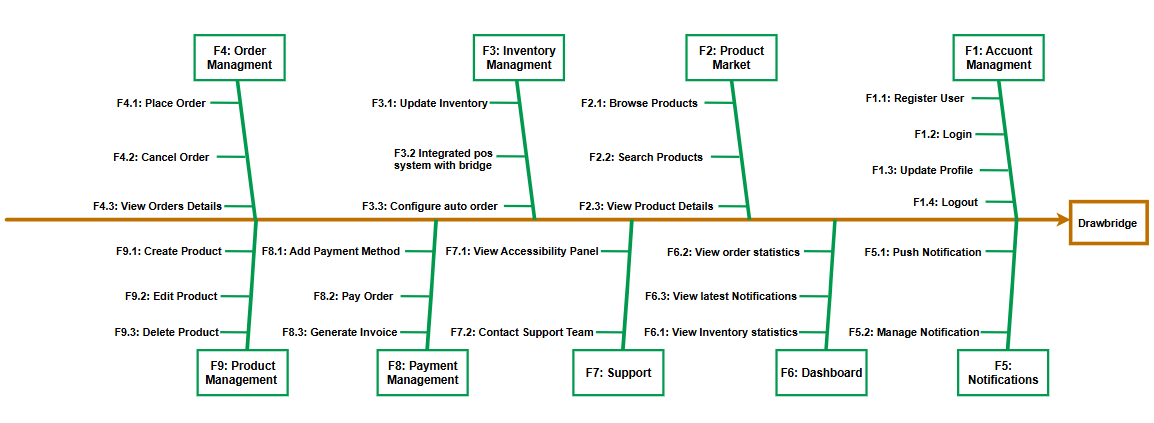
| ID | Feature Name | Feature Description |
|---|---|---|
F1 |
Account Management |
Allow users to create a new account, log in, update their profile, and log out of the system. |
F2 |
Product Market |
A central marketplace where retailers can find products by browsing or searching, review item details, and manage their cart from adding items through final checkout. |
F3 |
Inventory Management |
Enables retailers to manage their local inventory, configure automated reordering and manage POS system integration, and provides summaries and statistics on inventory performance. |
F4 |
Order Management |
Manage orders lifecycle for both retailers and wholesalers, allow access detailed order information, initiate and approve updates, process cancellations and completion. |
F5 |
Notifications |
The system sends notifications for important events, such as low inventory warnings, and provides a central place to view and manage notification preferences. |
F6 |
Dashboard |
Displays key business insights such as inventory and order statistics, and recent notifications in one place. |
F7 |
Support |
Provides accessibility options and contact method with the support team. |
F8 |
Payment Management |
Allow user to add and save preferred payment methods, execute payments for orders, and generate invoices, store detailed payments history. |
F9 |
Product Management |
Provides wholesalers with the ability to create and manage the products they intend to sell. |
Drawbridge Methodology
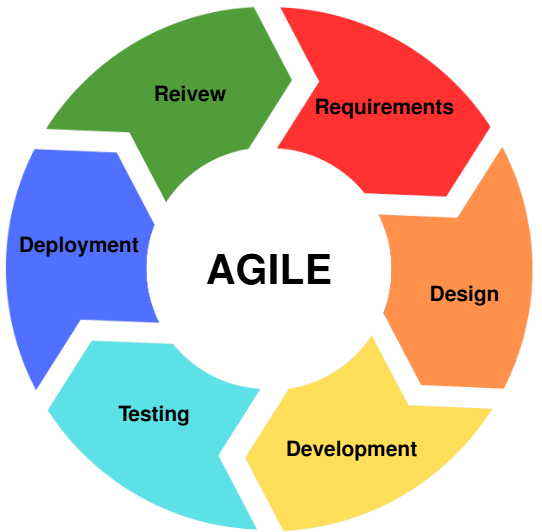
The Drawbridge project will be developed using Agile methodology, which is an iterative and flexible approach to software development and project management that emphasizes collaboration, customer feedback, and the rapid delivery of small, functional project components. It also focuses on adapting to changes and continuous improvement.
Agile Development Process
The Agile methodology breaks Drawbridge down into several dynamic cycles, called iterations or sprints. Each iteration includes a complete software development life cycle, which includes steps: planning, analysis, design, development, testing, and review. Then collect feedback for the next iteration. This cycle continues to achieve adaptation to changes and continuous improvement.
The 4 core values and 12 principles presented below are derived from the original Agile Manifesto.
The 4 Core Values of Agile methodology
-
Individuals and interactions over processes and tools: a collaborative and understanding team is more important than the use of the tools.
-
Working software over comprehensive documentation: Software that works and does the job is more important than producing bulky documents.
-
Customer collaboration over contract negotiation: The communication with the client and understanding their needs is more important than literally adhering to the contract.
-
Responding to change over following a plan: The ability to quickly adjust a project in response to changes is more important than sticking to a pre-existing plan.
The 12 Principles of Agile methodology
-
Customer satisfaction through early and continuous delivery of software.
-
Dealing with changes, even late in development.
-
Deliver working software frequently.
-
Collaboration between business and developers.
-
Build projects around motivated individuals and trust them.
-
Face-to-face communication is the most efficient and effective method to exchange information.
-
Working programs measure progress.
-
Maintain a sustainable pace for sponsors, developers, and users.
-
Continuous attention to technical excellence and good design enhances agility.
-
Simplicity-maximize the amount of work not done.
-
Teams self-organize to deliver the best outcomes, like architecture, requirements, and designs.
-
Regularly reflect and adjust the team behaviours for improvement.
(Beck et al., 2001)
Resource Requirement
Resource requirements are essential to the project’s success, so we used some advanced hardware and software to help us with this project. The details are as follows:
Hardware Includes
-
Computers: PC or laptops with support for the required software.
-
Router: provides internet access
Software Includes
-
Trello: To manage tasks.
-
Webex: For remote team meetings.
-
Microsoft Word: To write reports.
-
Draw.io: To create a UML diagram.
-
Figma: for designing the prototype.
-
IntelliJ IDEA: IDE for professional development.
-
Microsoft Windows: an operating system for computers.
-
Visual Studio Code: Lightweight IDE for web and cross-platform development
Report Layout
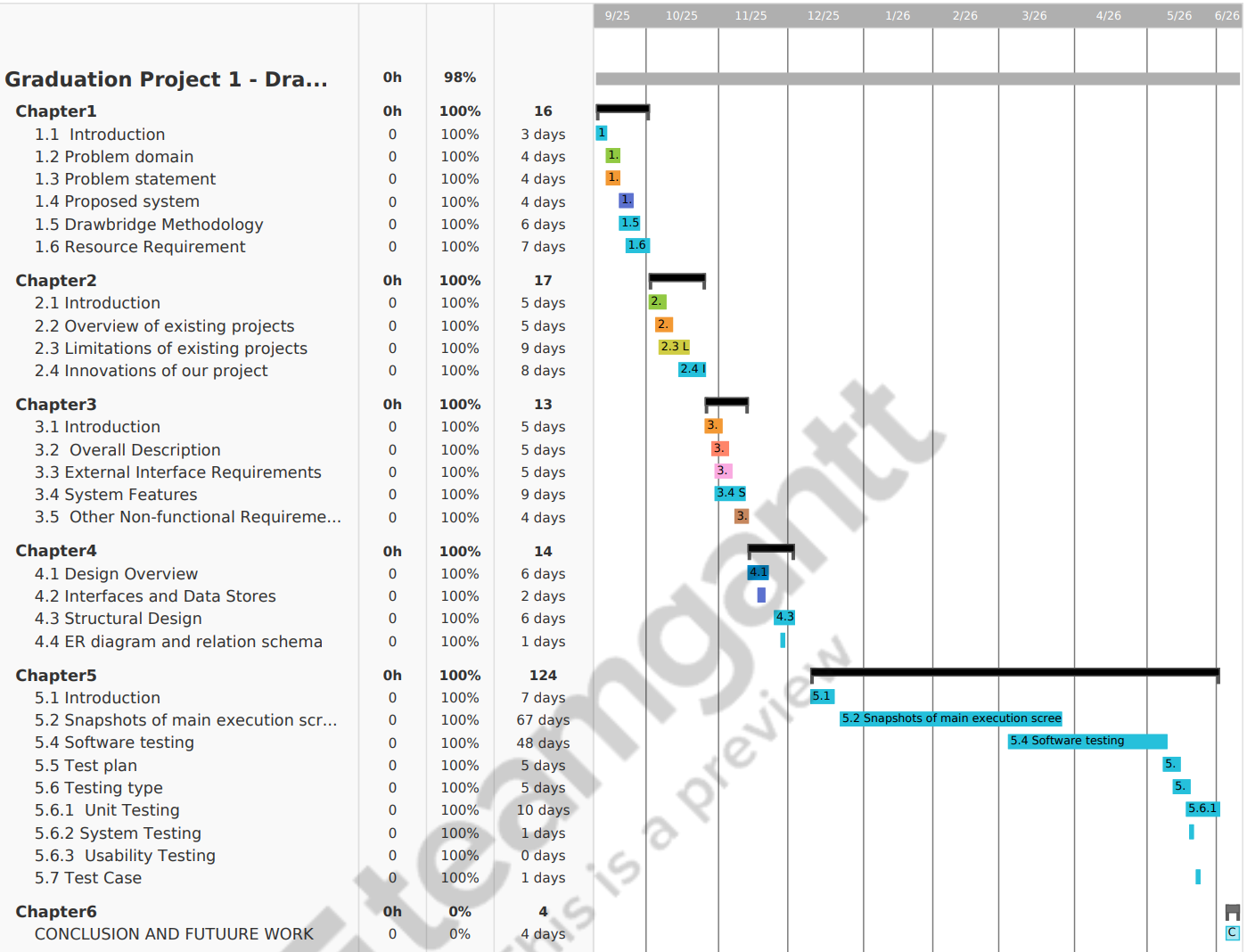
Chapter 1: Introduction - Introduces the project, problem domain, problem statement, objectives, the proposed system, project methodology, and resource requirements.
Chapter 2: Background / Existing Work - Reviews existing projects, highlights strengths and weaknesses, and presents proposed innovations.
Chapter 3: Software Requirements Specifications (SRS) - Defines detailed software requirements.
Chapter 4: Software Design - Explains system design and translates requirements into a software structure.
Chapter 5: System Implementation & Validation - Implements the system and validates its correct functionality.
Chapter 6: Conclusion & Future Work - Summarizes results and suggests future improvements.